
If your keys wander, shoes pile up, and mail sprawls across the first flat surface you see, you’ll love this: entryway organization for a small apartment isn’t about buying more stuff; it’s about putting every inch to work with a calm, repeatable system. The goal is a landing zone that catches life at the door—coats, bags, shoes, parcels—without eating precious square footage or risking your deposit. Below you’ll find real measurements, layouts that fit tight hallways, renter-safe installs, and simple habits that keep the space tidy on autopilot.
Start here: map the space you actually have
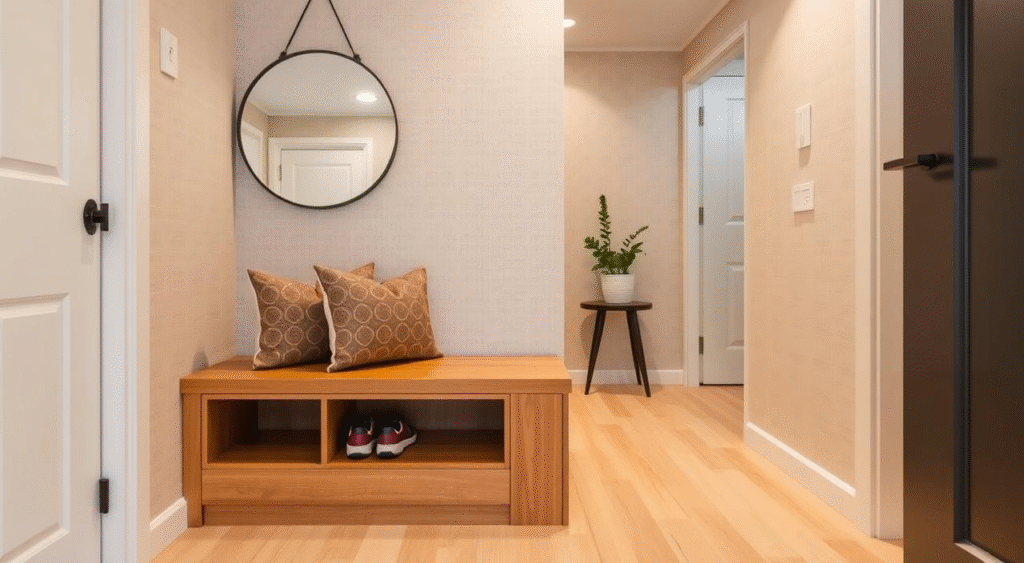
- Measure width, depth, ceiling height, and door swing (front door + any closet doors).
- Note “traffic lines”: the natural path from door → kitchen/living. Furniture should never jut into that line.
- Find vertical opportunities: above-door voids, the 30–72 cm (12–28 in) between door trim and corner, and awkward nooks you’ve been ignoring.
- Decide the non-negotiables for your household: one hook per person, hidden shoe storage, a mail drop, and a spot for umbrellas/dog leash.
Typical small-entry footprints (and what fits)
| Entry width | What fits comfortably | What to avoid |
|---|---|---|
| 60–75 cm (24–30 in) hallway | Narrow wall rack, over-door unit, slim shoe cabinet (≤18 cm/7 in) | Deep consoles, bench deeper than 35 cm (14 in) |
| 90–110 cm (35–43 in) | Slim console with drawers, 2–3 wall hooks, umbrella stand | Cube benches, bulky coat trees |
| 120+ cm (47+ in) | Closed shoe cabinet + bench, gallery shelf, peg rail | Freestanding wardrobes unless recessed |
Layouts that always work (pick one and commit)
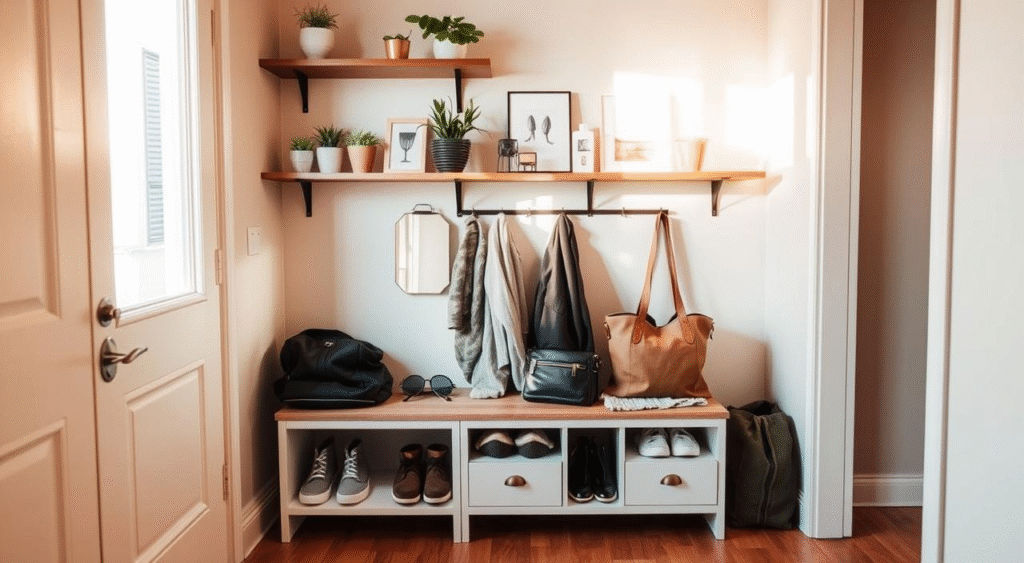
The Slim Spine (for corridors): one continuous vertical “spine” on the wall with upper shelf + peg rail + shoe cabinet below. Everything stacks, nothing protrudes.
The L-Corner: use the short wall near the hinge for hooks, long wall for a narrow console. Turn the corner with a mini basket tower.
The Bench Block: low, closed shoe storage doubles as a bench; floating shelf above for keys and mail; hooks centered between.
The Door-Back Workhorse: over-door rack (coats/bags) + over-door fabric pockets (gloves/hats/masks). Keep the wall clear to widen the feel.
Vertical first: make the walls carry the load
- Floating ledge (8–12 cm/3–5 in deep): holds trays, sunglasses, postage—without feeling bulky.
- Peg rail (at 140–155 cm / 55–61 in from floor): one peg per person + two “guest” pegs. Pegs keep coats from stacking on chairs later.
- Above-door shelf (use 2 brackets into studs if allowed or compression poles if not): seasonal baskets for hats, mittens, spare bulbs.
- Magnetic strip by the door (if your frame is steel): keys and dog lead live here—micro habit changer.
“Small entries aren’t storage problems; they’re decision problems. Give every item a default home within arm’s reach of the door.”
Renter-friendly installs (no holes required)
- Adhesive hooks: choose weight rating ≥2× what you plan to hang. Clean with isopropyl, press 30 seconds, let cure.
- Tension rails/rods: inside alcoves for hanging S-hooks and baskets. Great above radiators where consoles won’t fit.
- Over-door systems: look for felt-padded arms and adjustable hook clearances so doors still latch.
- Leaners: ladder shelves and lean mirrors add vertical function without hardware.
Shoe storage that doesn’t eat the hallway
- Flip-down shoe cabinets (depth 12–18 cm / 4.7–7 in): unbeatable in tight corridors.
- Bench with drawers, not open cubbies: hides visual clutter and dust; top doubles as seat.
- Under-bench rolling tray: for wet boots—line with a boot mat.
- Seasonal rotation: only the current week’s shoes at the door; everything else in under-bed bins.
Quick chooser: which shoe solution fits you
| Need | Best option | Why it works |
|---|---|---|
| Very narrow hall | Flip-down cabinet | Ultra-shallow, wall-hugging |
| Kids + daily chaos | Closed bench drawers | Fast stash, soft-close safer for fingers |
| Pet households | Boot tray on casters | Contains mud, easy to roll out and mop |
| Style display | Ladder shelf with boxes | Vertical, airy, easy to curate |
Surfaces that stay clear (even on busy mornings)
- Use an inset tray on your ledge/console for “drop zone” discipline (keys, wallet, earbuds). When the tray is full, you sort—built-in limit.
- Stand mail vertically in a file or magazine rack labeled In / Out / To shred.
- Pen + sticky pad live on a tiny command-mounted cup—sign for parcels without hunting.
Light, mirrors, and the “bigger room” trick
- Mirror opposite the door (or at 90°) bounces light and widens the corridor.
- Plug-in sconce with cord cover or a battery picture light over the ledge makes the entry glow like a hotel—instant calm.
- Warm bulbs (2700–3000K) flatter coats and skin tones; harsh light makes clutter feel worse.
Style the workhorses so they look intentional
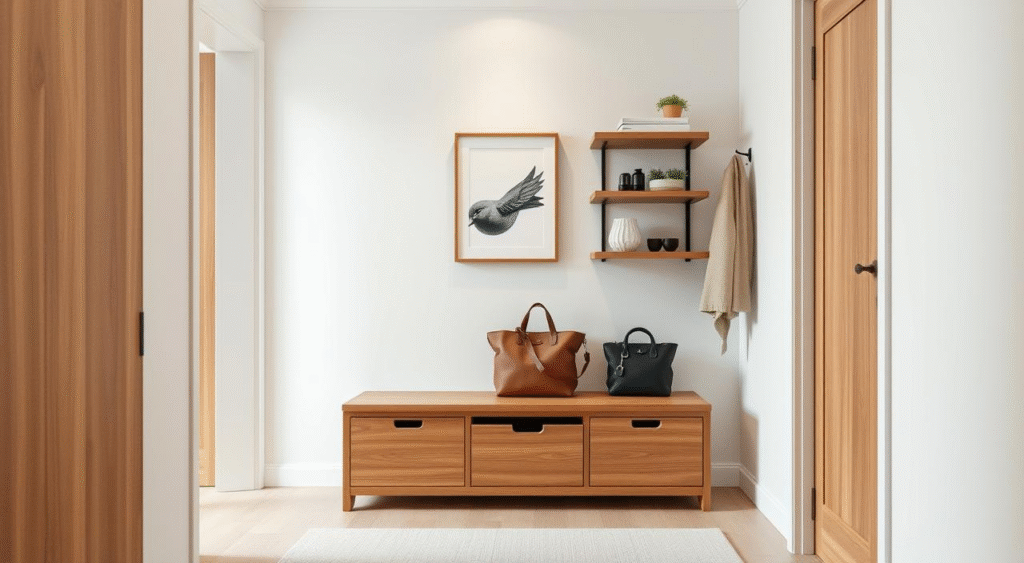
- Repeat two finishes max (e.g., black metal + oak) across hooks, frames, and shelf edges for a quiet, unified look.
- Choose lidded baskets for top shelves—visual silence. Label the inside front so tags don’t shout at you.
- Add one living element (a small plant or sprig in a bud vase). It signals “this space is cared for,” which nudges tidiness.
A five-item toolkit that solves 90% of problems
- Adhesive hooks (mixed weights)
- Narrow tray (drop zone)
- Slim shoe cabinet or closed bench
- Floating ledge (keys/mail)
- Over-door multi-hook (overflow coats/bags)
The 7-minute daily reset (really)
- Shoes into cabinet, coat on peg, bag on same peg every time.
- Empty tray: keys stay, receipts move to In, junk mail to Shred.
- Quick swipe of the ledge and mirror.
- Weekly: vacuum the threshold, launder the boot mat, clear the “Out” pile.
Budget pathways (under $50, under $150, under $300)
| Budget | What to buy | Why it’s enough |
|---|---|---|
| ≤ $50 | 6 adhesive hooks, over-door rack, small tray, two fabric bins | Hooks do the heavy lifting; bins hide hats/gloves |
| ≤ $150 | Slim console/ledge, mirror, closed shoe bench or flip-down | Adds surfaces + closed storage + visual width |
| ≤ $300 | Add peg rail, plug-in sconce, above-door shelf with baskets | Vertical capacity + better light = lasting order |
Micro-spaces: when your “entry” is basically a door
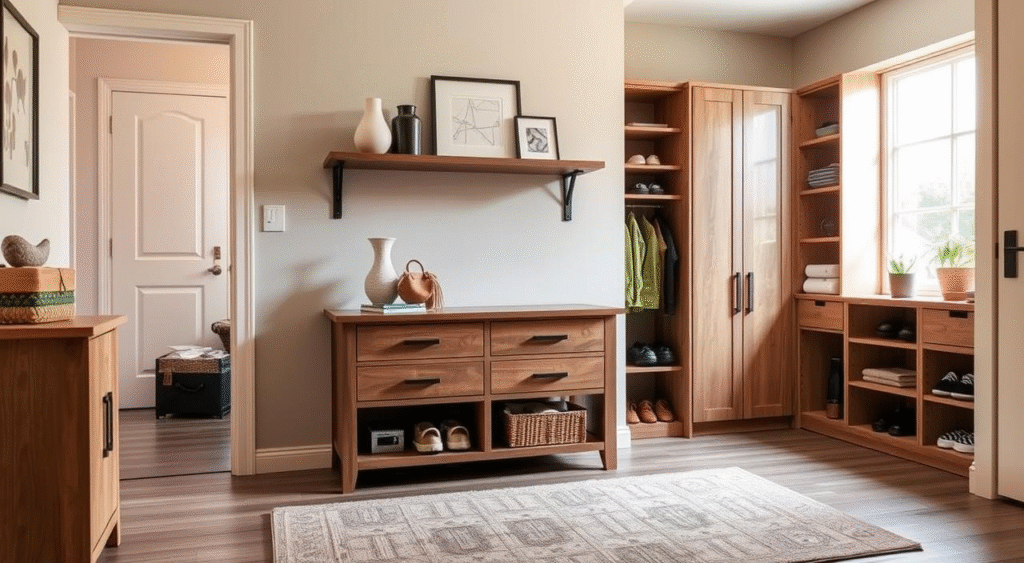
- Command ledge (keys), over-door rack (coats), boot tray (shoes), and a wall file (mail) stacked in 45 cm (18 in) of wall. Done.
- Use the hinge-side sliver: a 10 cm (4 in) deep vertical rail can hold 4–6 hooks with zero crowding.
Families, pets, and shared flats
- Color-code hooks (or add name tags) so kids stop “borrowing” each other’s pegs.
- Leash station by the door: hook + treat tin + roll of bags in a command cup.
- Roommates: one hook + one shoe slot per person, labeled. Overflow lives in bedrooms—house rule.
Cleaning plan that won’t wreck your rental
- Felt pads under benches and cabinets; they glide without scuffing.
- Boot mats catch gravel; shake outdoors weekly.
- If you must use adhesive, warm it with a hair dryer before removal; pull tabs straight down to avoid lifting paint.
Common mistakes (and easy fixes)
- Too deep furniture in a narrow hall: swap to a flip-down or wall rail—keep depth under 18 cm (7 in).
- All open storage: convert the biggest visual offender to closed (bench drawer or lidded baskets).
- Hooks too high/low: center peg rail at 145 cm (57 in) so coats don’t drag or loom.
- One lonely hook: add enough capacity for real use—one per person plus guest and gym bag.
Sample setups you can copy
The Corridor Calm (75 cm/30 in wide)
- Flip-down shoe cabinet (80–100 cm wide)
- Floating ledge above with 30 cm tray
- Peg rail for 4 pegs
- Over-door rack for guests
- Runner rug to visually elongate
The Studio Nook
- Closed bench (80–100 cm) with two drawers
- Round mirror (60–80 cm) above
- Slim wall file (In/Out) + small table lamp (plug-in)
- Two baskets under bench: scarves & gym kit
Quick reference: what each solution does best
| Solution | Best for | Watchouts |
|---|---|---|
| Flip-down shoe cabinet | Narrow halls, visual calm | Needs wall contact; check baseboard cuts |
| Closed bench | Families, pet homes | Measure depth; choose wipeable finish |
| Peg rail | Fast coat access | Don’t overload with bags + coats on one peg |
| Floating ledge | Key/mail control | Keep depth shallow to avoid bumps |
| Over-door rack | Renters, zero wall space | Pad the hooks to protect paint |
small entry, big routine
A tiny entrance can run like a well-oiled station when walls do the lifting, surfaces stay shallow, and every person has a clear home for their stuff. Start with one layout (Slim Spine, L-Corner, Bench Block, or Door-Back), choose closed storage for shoes, and install a ledge + peg rail at human height. Add a mirror for light, a tray to limit clutter, and a seven-minute reset that happens on autopilot. Do this, and your entryway organization for a small apartment will hold up on the busiest days, not just after a weekend tidy.
FAQs
How deep should entry furniture be in a narrow hallway?
Keep it under 18 cm (7 in) for flip-downs and under 35 cm (14 in) for benches. You should move past without shoulder bumping.
What’s the best shoe storage when I have no width?
A flip-down cabinet or a wall-mounted shoe rack with angled shelves. Both hug the wall and clear the walkway.
How high should I mount hooks?
Aim for 145 cm (57 in) to center. Add a low set at ~100 cm (39 in) if kids share the space.
Can I organize without damaging walls?
Yes—adhesive hooks, tension rails, over-door systems, and leaners. Clean surfaces before mounting and let adhesives cure for best hold.
How do I keep the surface clear?
Use a tray as a visual quota. Stand mail vertically in a labeled file, and empty the tray every night during your seven-minute reset.
What rug works best for entries?
Low-pile, washable runner with a non-slip underlay. Dark or patterned hides city grit and pet paw prints.
Where do umbrellas and wet boots go?
Boot tray with a lip under the bench and a slim umbrella stand or wall hook with a drip tray. Line trays with a cut-to-fit rubber mat for easy cleaning.
I rent—what’s safe to mount?
Go for adhesive hardware rated for weight, over-door organizers, and furniture that leans or stands. If you must drill, ask first and use existing studs; patch/paint on move-out.
What if my entry is literally a door opening into the living room?
Use a command ledge for keys, a wall file for mail, an over-door rack for coats, and a slim shoe tray. One meter of organized wall is enough to keep the rest of the room sane.
How do I make it feel welcoming, not utilitarian?
Repeat two finishes, add a plant, choose closed storage for the messiest category (usually shoes), and warm the light. The prettiest entry is the one that quietly works.