
If getting dressed feels like a scavenger hunt, you don’t need a bigger wardrobe—you need better small closet organization. The aim isn’t perfection; it’s fast, repeatable order. Below are 10 field-tested tips (with measurements, budgets, and product types) to turn a cramped closet into an easy, everyday system.
Why small closets get messy (and how to fix that fast)
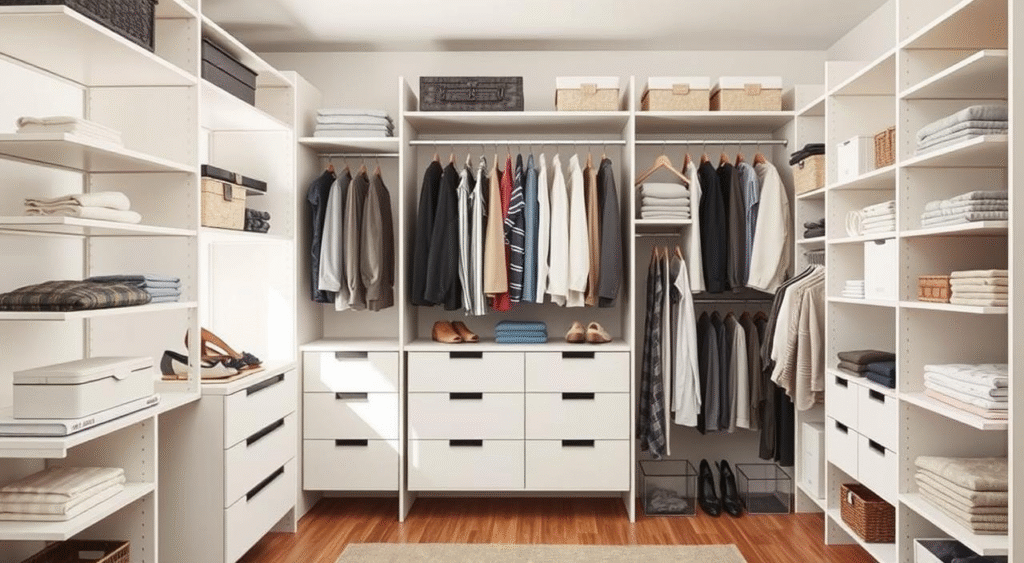
Closets fail for three reasons: no limits (too much in, nothing out), no zones (everything everywhere), and no helpers (wrong hangers, no dividers). Your fix is a short routine, clear capacity limits, and storage that guides behavior—hooks, rails, bins, and labels that make the “right” spot obvious.
The 10 tips
Tip 1: Do a ruthless, one-evening inventory
Empty the closet completely. Group by type (tops, bottoms, dresses, outerwear, shoes, bags, occasion wear). Try things on; be honest about fit and comfort. Hold a laundry basket for keeps, a bag for donations, a box for resale, and a bin for repairs. If you’ve skipped it for a full season and it isn’t formalwear or sentimental, it’s a contender to go.
Keep/donate quick table
| Category | Keep if… | Donate/sell if… |
|---|---|---|
| Tops | Fits, you wore it in last 90 days, color flatters | Tight, scratchy, duplicates |
| Pants/jeans | Waist/hip comfortable, hem works with shoes | “Someday” sizes, dated rise that you avoid |
| Shoes | You can walk 30 minutes pain-free | Blister-makers, damaged pairs you won’t repair |
| Coats | Weather-appropriate, layers over blazers | Duplicates in same color/weight |
| Pro move: Make a “test rack” of five maybes. If unworn after two weeks, out they go. |
Tip 2: Give everything a numeric limit
Space is the boss. Assign maximums by category that fit your actual rod/shelf length. Example: 80 cm of rod space = about 20 slim hangers. Decide your number, then stick to it.
Capacity cheat sheet (using slim velvet hangers): 1 meter of rod ≈ 25–28 blouses or 18–20 jackets. One 30 cm shelf ≈ 2 stacks of denim (10–12 pairs total) or 3 sweater stacks (6–9 sweaters).
Tip 3: Double your hanging with two rods
Install a second rod under the first for short items. Target 100–105 cm (39–41 in) for the lower rod and 180–185 cm (71–73 in) for the upper. Put blouses/skirts on top, pants folded over hangers on bottom. Keep dresses and long coats on a single-rod section at one end.
Why it works: You’re creating “zones” by height, which stops tangles and wasted airspace.
Tip 4: Use one hanger style (and the right ones)
Match hangers so clothes sit at the same level. Use slim velvet for tops/dresses (no shoulder bumps), wood or flocked suit hangers for blazers/coats, clip hangers for skirts. Keep 10% spare for laundry day—no more.
Quick wins: Add foam shoulder shapers for delicates; swap wire/odd hangers immediately.
Tip 5: Turn shelves into drawers
Shelves become clutter mountains without boundaries. Add acrylic shelf dividers to stop leaning stacks, and use bin-drawers with pulls for tees, gym gear, and scarves. File-fold items so you see edges, not piles. Label the shelf edge on the inside so it looks calm from the doorway.
Good candidates for bin-drawers: tees, leggings, sleepwear, soft accessories.
Tip 6: Take over doors and dead air
The back of the door is prime real estate. Use an over-door rack for belts, bags, hats, and scarves. Add a 10–15 cm (4–6 in) deep hook rail to the wall side for tomorrow’s outfit. Above the top shelf, mount a light, lidded tote row for out-of-season pieces.
Label ideas (front, small script): WINTER HATS, SWIM, COSTUMES, SKI BASE LAYERS.
Tip 7: Put shoes on a vertical system
Get them off the floor. Options that fit almost any closet:
- Drop-front shoe boxes (see-through, stackable): best for sneakers/heels; dust-free.
- Narrow vertical tower (30–35 cm wide): fits 10–12 pairs in tiny footprints.
- Over-door pockets: great for flats/sandals; dedicate lower rows to slippers/house shoes.
Rule of five: no more than five pairs live on the floor (the week’s rotation). Everything else earns a container or tower slot.
Tip 8: Create a micro-zone for accessories
A shallow tray for watches and everyday jewelry, a felt-lined box for occasion pieces, a small command hook for the belt you wear most. For scarves, use multi-ring hangers. For bags, stuff with old tissue or dust bags to keep shape and hang by the strap base, not the handle.
Tiny frustrations to solve: where your lint roller, spare buttons, and travel sewing kit live—give them a labeled bin.
Tip 9: Light it like a display
You can’t wear what you can’t see. Add battery motion-sensor puck lights under shelves and a stick-on LED bar along the inside jamb. Warm white (2700–3000K) is kinder to colors and skin.
Bonus: A cheap peel-and-stick mirror on the inside door removes extra trips to the hall mirror.
Tip 10: Install a 10-minute weekly reset
Pick one recurring slot (Sunday evening works). The script: return strays, rebuild stacks, refill cedar sachets, move off-season to top bins, wipe shelf dust, and run a quick “hanger test” (anything not worn this season moves to the test rack). This keeps the closet honest without marathon cleanups.
Small closet organization layouts (copy these)
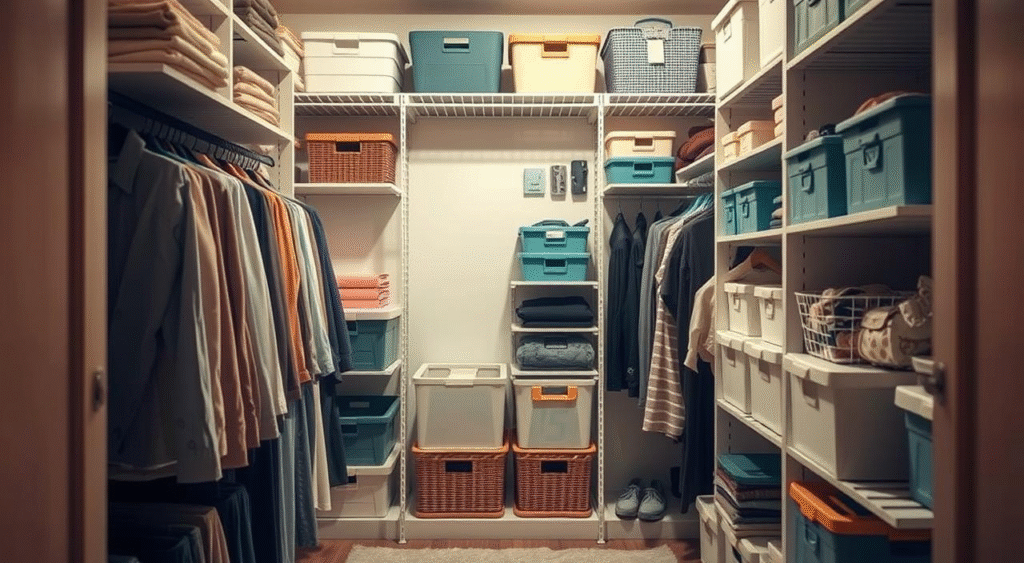
Single door, 1 m rod + 1 shelf: add second rod on right half; left half stays long. Shelf: three bin-drawers; door back: over-door pockets for flats. Floor: one 30 cm tower for everyday shoes.
Reach-in with sliding doors: sliding tracks limit access—center your most-used categories. Use low-profile drop-front boxes so doors still glide. Mount a hook rail on the interior side wall for bags.
No shelf at all: add a tension shelf at 200 cm (79 in) and a second at 220 cm (87 in) for light bins; use a freestanding narrow tower for folded items.
What to store where (simple map)
| Zone | Put this here | Why |
|---|---|---|
| Eye level (120–160 cm / 47–63 in) | Daily tops, jackets | Fast grab, best visibility |
| Lower rod/shelf | Pants, activewear, shoes | Heavier items below, easier to file-fold |
| High shelf | Out-of-season, occasion wear | Infrequent use lives up high |
| Door back | Belts, hats, scarves, flats | Slim items that benefit from vertical access |
Tools that make the biggest difference (on any budget)
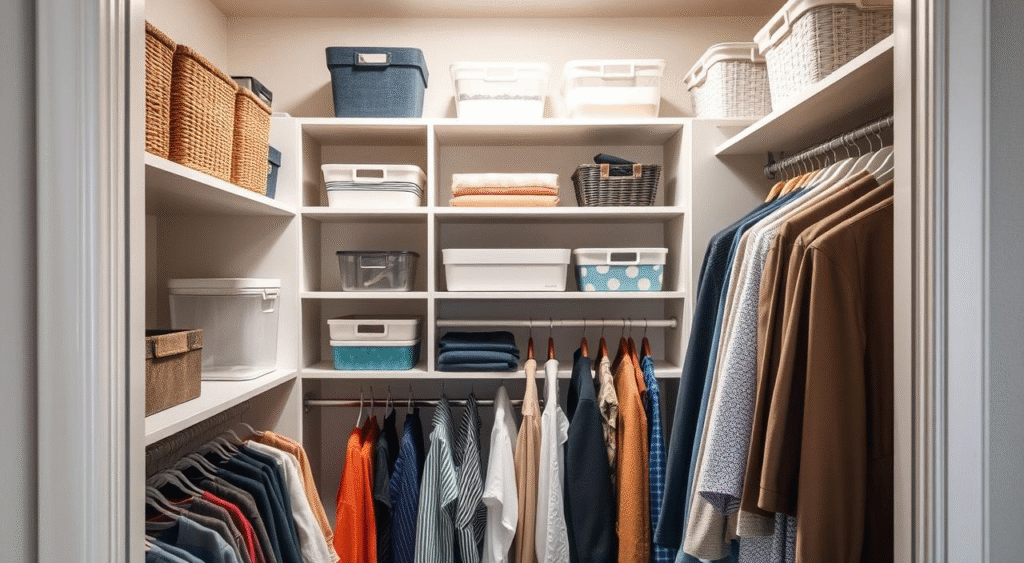
- Slim velvet hangers (a full swap is transformational)
- Acrylic shelf dividers (stop “sweater slide”)
- Drop-front shoe boxes or a narrow tower
- Over-door multi-hook or pockets
- Bin-drawers with front pulls
- Battery motion lights
- Fabric labels or a label maker (legible, consistent)
Budget planner
| Budget | Buy first | Result |
|---|---|---|
| Under $60 | Slim hangers + over-door rack + 2 bin-drawers | Instant rod space + a home for accessories |
| Under $150 | Add shelf dividers + drop-front shoe boxes + lights | Better stacks + visible shoes + see-what-you-own lighting |
| Under $300 | Add second rod + narrow shoe tower + more bins | True doubling of capacity + floor cleared |
Hangers vs. folding: what belongs where
Hang: blazers, dresses, blouses, trousers with a crease, anything that wrinkles easily.
Fold: knits, tees, denim, gym gear.
Roll (file-style in bins): scarves, leggings, sleepwear.
Rule of texture: if it stretches, fold it. If it creases, hang it.
The “quarantine rack” for indecision
Keep a slim rail or five empty hangers for uncertain pieces. Wear it within two weeks or let it go. This turns emotions into an easy rule and stops re-cluttering.
Scent and fabric care (so it stays fresh)
Add cedar blocks or sachets in each bin; swap every 3–4 months. Keep a small fabric shaver for pilled knits and a lint roller on a hook. Place a mesh laundry bag in the closet for delicates so they don’t scatter on laundry day.
Common mistakes (and the fix)
- Too-deep organizers: stick to 25–30 cm (10–12 in) depth for shelves/bins in small closets.
- Open shoe piles: contained boxes or a tower only—no teetering stacks.
- Mixed hanger types: standardize; the visual calm alone is worth it.
- Overflow on the floor: cap the floor to five pairs, period.
Sample one-hour makeover plan
0–10 min: Pull everything out, quick category sort.
10–25: Load keepers on matching hangers, set aside test rack maybes.
25–35: Install over-door rack, drop in two bin-drawers, place shelf dividers.
35–50: Shoes into boxes/tower, five-pair floor rule.
50–60: Labels on bins, lights mounted, top-shelf totes loaded.
High-value conclusion: a closet that helps, not hassles
When your closet does the thinking—clear zones, matched hangers, contained shelves, vertical shoe storage—you stop hunting and start dressing. The real win of small closet organization isn’t pretty stacks (though you’ll have those); it’s a calmer morning. Set a numeric limit, give each category a home, light the dark corners, and run a simple weekly reset. Do that, and even a narrow reach-in will feel like it grew a size without moving a single wall.
FAQs
How many hangers should I own for a small closet?
Count your rod capacity (roughly 25–28 tops per meter with slim hangers). Keep 10% spare for laundry; excess hangers encourage clutter.
Is double-hanging always worth it?
If most clothes are short-hanging, yes. Preserve a 30–40 cm section for long dresses/coats.
What’s the best shoe solution for tiny floors?
Drop-front boxes or a narrow tower. Over-door pockets are excellent for flats and sandals.
Do I need a full custom system?
Not usually. A second rod, dividers, a shoe tower, and door storage solve most small closets. Go custom for odd shapes or sloped ceilings.
How do I keep folded stacks from collapsing?
Shelf dividers + file-folding into bin-drawers. It’s the difference between a display and a landslide.
What lighting works if I can’t wire?
Battery motion pucks or stick-on LED bars (warm white). Place under shelves and along the jamb.
Where should out-of-season clothes go?
Top-shelf lidded bins, labeled and moth-protected. Vacuum bags for bulky coats if you’re truly tight on space.
How often should I declutter?
Run a 10-minute weekly reset and a bigger seasonal swap (spring/autumn). Use the two-week test rack for maybes.
What about sentimental items?
Curate a small keepsake box separate from daily clothes. Honor memories without overcrowding the rod.
Any quick win if I only have 20 minutes?
Swap hangers, add an over-door hook rack, and contain one shelf with two bin-drawers. You’ll feel the difference tonight.